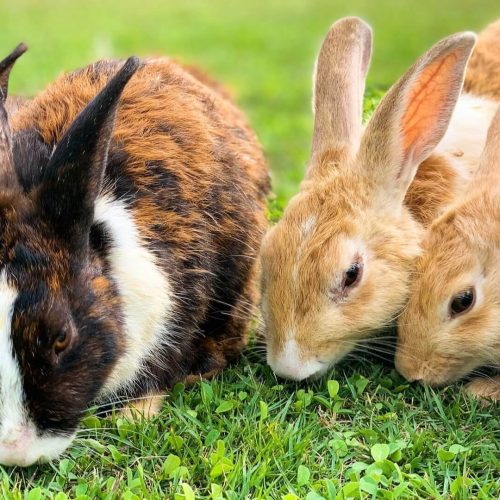
RABBIT NUTRITION
HAY
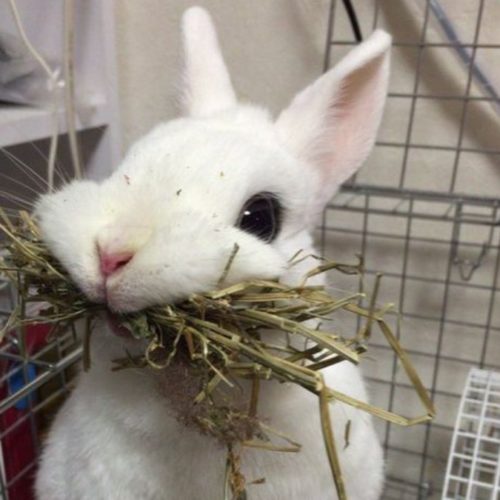
The most crucial part of a rabbit's diet is hay and lots of it! Provide unlimited hay to rabbits of all ages. Grass hay such as timothy is highly preferable to alfalfa, due to alfalfa's high calcium and fatty content. When choosing hay for your rabbit, keep in mind that the higher the fiber content, the more beneficial it is.
When considering different brands and types of hay, take note of the dust content and fresh (or stale) scent. If you find the smell a little appetizing, your rabbit is sure to as well! Some people have described the fresh scent of hay as being reminiscent of tea.
The importance of hay in your rabbit's diet can never be stressed enough. Rabbits who are not given hay can easily develop molar spurs (leading to much more serious medical issues), or disturbances of the GI tract (please see Health for more information).
If you find your rabbit unwilling to eat hay, try a different brand. Try buying locally to increase the chances of freshness. Rabbits from certain environments, such as ones in which they were overfed pellets, commercial treats or fruit, can be quite stubborn about eating what's good for them. Try the following tricks to get your bunny's hay appetite stimulated.
Reduce the amount of pellets given – surprisingly enough to some new rabbit owners, they are far less essential to a rabbit than hay
Present hay in a different manner – perhaps in an untreated willow basket, an empty tissue box or paper towel roll, a hay rack or even in the litter box. A rabbit will eat only the unsoiled hay as they relax in their boxes
Use the hay as bedding for the rabbit. Again, they will eat what is unsoiled and leave the rest
Did you have trouble getting your rabbit to eat hay? Email us your suggestions to help us help others!
Recommended hay brands:
Bourne Free Farms Exceptional Mixed Grasses
Kaytee Brand Timothy Hay
Oxbow Hay Products
Sun Seed Autumn Harvest Sweet Grass and Western Cut Timothy
Zupreem Nature's Promise Timothy and Orchard Grass
If purchasing bales of hay from a local farm, take note of the following:
Where the farm's hay is stored. Improper storage can cause toxic moulds to grow.
Ask about the presence of raccoons. Raccoon feces can carry a parasite that is fatal to rabbits.
Pesticide usage. Avoid those that do use such products.
Ensure the hay has no alfalfa content.
Ensure there is no milkweed present.
PELLETS
Choosing a brand
For young rabbits up to 5-7 months of age, alfalfa-based pellets are acceptable, however after this point, a timothy-based pellet should be slowly introduced instead.
Avoid under all circumstances pellets that contain seeds, corn, nuts or cereal bits. These may be visually appealing to people, however, they are NOT healthy for your rabbit. Corn, seeds and nuts are not easily digested (with the potential of leading to GI blockages) and are extremely fattening. For the sake of your rabbit, please avoid these choices!
Daily Feeding Amount
Pellets should be fed free choice up to 6-7 months of age, at which time the diet should be supplemented with vegetables. At 7 months, while slowly introducing your choice of timothy-based pellet, the amount should be gradually reduced to 1/8 cup-1/4 cup per day by the time the rabbit is one year old.
Remember, the main part of your rabbit’s diet should be hay and if you notice a decrease in his hay consumption, reduce his pellets.
Recommended pellet brands for adult rabbits:
Martin Mills Less Active Adult Rabbit Food
Oxbow Bunny Basics/T
Zupreem Nature's Promise Premium Pellets
Recommended pellet brands for juvenile rabbits:
Martin Mills Rabbit Food
Mazuri Rabbit Diet
Oxbow Bunny Basics
VEGETABLES
Begin feeding fresh vegetables to your rabbit at approximately 6-7 months of age. Introduce each vegetable slowly so as not to induce an overproduction of cecotrophs (see Health for more information on this unique function) or true diarrhea, known as enteritis.
Once fully introduced to vegetables as part of their regular diet an average sized rabbit will eat 1-2 cups of greens per day. Please keep in mind your rabbit's size when doling out her daily greens! This is only a very rough guideline. Please see the list of rabbit-safe vegetables at right.
FRUIT
Fruit should be given sparingly, as its high sugar content could lead to obesity and/or gastrointestinal issues (such as an overproduction of cecotrophs mentioned above). A good example would be four to five small slices of apple for an average sized rabbit per week. Please see the list of rabbit-safe fruit at right.
COMMERCIAL TREATS
Please limit your use of commercial treats to those that are safe! As with pellets containing seeds, nuts and corn, most are prepared to be appealing to humans. Feeding most types of commercial treat can lead to obesity, intestinal obstructions or other various health problems. Use simple treats OR limit your rabbit's treats to fruit, steel cut oats and simple wheat based cereal (sparingly!), all in reasonable amounts!
Another alternative to fresh fruit (in perfect bunny bite-sized bits) are freeze dried toddler fruit snacks, made with 100% freeze-dried fruit and no artificial colours or flavours. They taste just like fresh fruits! They can be found in the baby and toddler food section of your local grocery store.
Recommended commercial rabbit treats:
Martin Mills Little Friends Hearty Apple Dumplings
Oxbow Organic Barley Biscuits
Oxbow Simple Rewards Banana/Strawberry/Timothy/Veggie Treats
Oxbow Papaya Fruit Plus
Snak Shak (by 8-in-1 Ecotrition)*
Please visit New Moon Rabbit Rescue's online Gift Shop for other healthy rabbit treats!
*Except "Snak Shak Treat Stuffers"
WATER
Fresh water must be provided at all times. Change the water frequently (every day), and clean the bowls thoroughly. If you are on well water, rather than city, spring water is better than tap water, as some impurities such as excess calcium, can cause health issues such as urine sludge.

REGISTERED CHARITY
# 82515 0329 RR0001


RABBIT-SAFE VEGETABLES
Arugula |
RABBIT-SAFE FRUIT/TREATS
Apple (no stem or seeds) |